ASTRA-OS is a C++17 flight-software testbed for command validation, telemetry, mode management, FDIR, fault injection and requirements-based verification.
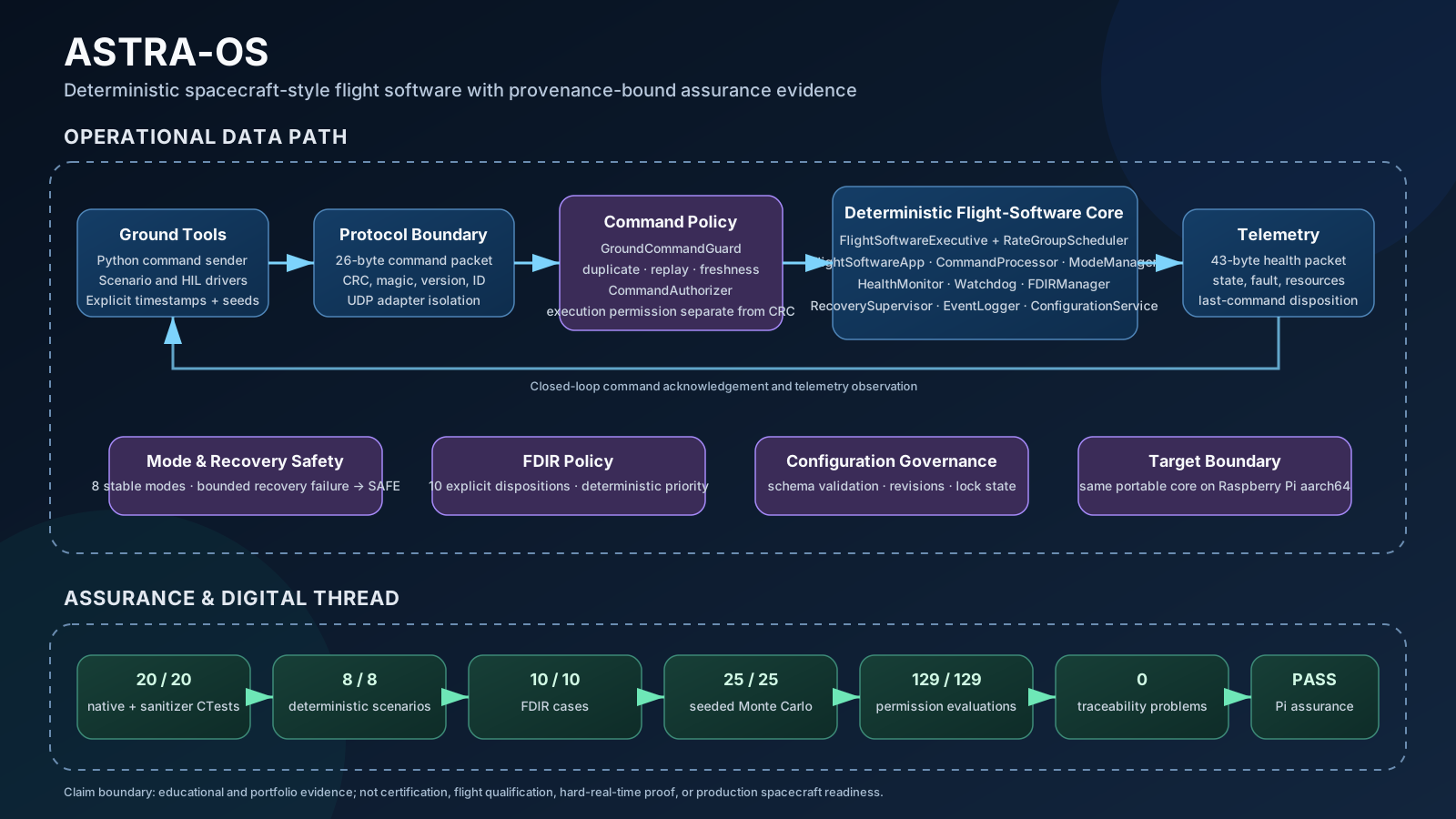
The architecture, telemetry timelines and assurance counts below come directly from the public repository. The interactive console is labeled separately because it is a browser model of the documented state machine, not the native C++ executable.
Command decoding, replay/freshness guards and execution authorization are separate boundaries before state mutation. Telemetry and provenance-bound verification close the loop around the deterministic flight core.
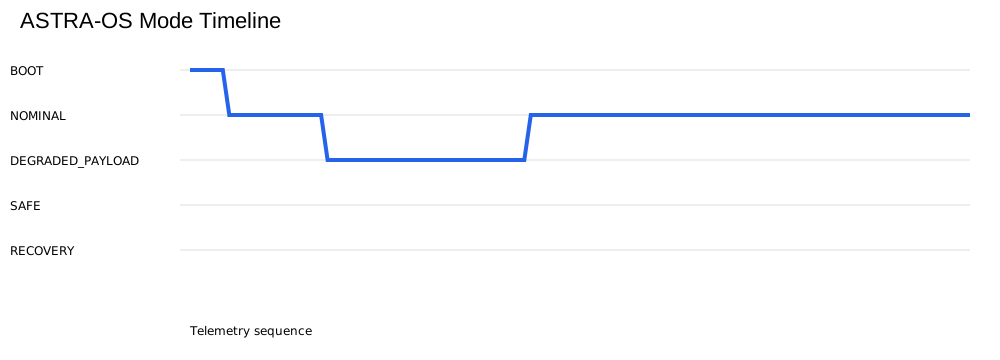
The preserved demo sequence leaves BOOT for NOMINAL, enters DEGRADED_PAYLOAD on the injected CPU-overload path, then returns to NOMINAL after fault clear and an accepted SET_MODE command.
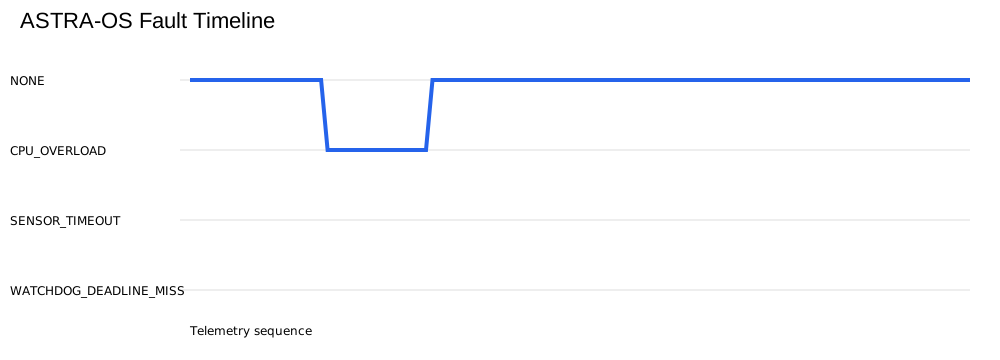
The same sequence makes the injected CPU_OVERLOAD interval and subsequent clear visible in telemetry. This is a software-policy response, not verification of every physical detector or recovery mechanism.
Use the public console to issue documented commands and faults and observe modeled mode, fault and telemetry responses. It is intentionally not described as WebAssembly, the native executable or a live Raspberry Pi session.
Choose a frame, flip a bit on the wire, and watch the ground-segment acceptance chain reject it at the exact check that catches the damage. The fault switches step the FDIR mode the same way the flight build does.
This model needs JavaScript. Everything it demonstrates is described in the sections below.
02Problem
Writing a mode manager or UDP packet parser is easy to demonstrate. Showing that the software rejects the wrong command, enters a safe state on the right fault, bounds recovery attempts, preserves event history and remains traceable to requirements is the harder engineering problem.
ASTRA-OS treats that verification chain as part of the product rather than a report written after implementation.
03Architecture
Flight segment
Eight deterministic operating modes
Health and watchdog monitoring
FDIR with simultaneous-fault priority
Bounded recovery supervision
Rate-group scheduler and typed event logging
Binary command and telemetry packets
Ground / assurance segment
Python command sender and telemetry decoder
YAML-driven deterministic scenarios
Fault injection and FDIR campaign
Seeded Monte Carlo regression
Protocol-conformance and requirement gates
Sanitizer, static-analysis, mutation and fuzz checks
The command path explicitly distinguishes packet integrity, freshness/replay policy, execution authorization and semantic validation. CRC detects corruption in the tested model; it is not presented as cryptographic authentication.
04Current assurance campaign
20/20
Native CTest
8/8
Scenarios
10/10
FDIR cases
24/24
Protocol
25/25
Seeded MC
35/35
Python / web
129/129
Policy eval
0
Requirement failures
These counts summarize the current repository tree. Frozen completion and release reports keep the smaller Python-tool counts measured at their own commits; the repository reports and CI remain authoritative if the implementation evolves.
05Raspberry Pi target evidence
The completion campaign built and executed the portable core natively on Ubuntu 24.04 aarch64 with a Raspberry Pi kernel. The collection interface did not expose an authoritative board or SoC model, so the project does not guess one.
Campaign
Observed result
Scope
Native test run
20/20 CTest suites passed
Pinned target campaign
Nominal timing
250,000 ticks; 0 detected misses
Faster-than-real-time process measurement
Controlled overrun
99 expected misses detected in 100,000 ticks
Synthetic overload every 1,000 ticks
Soak
1,000,000 ticks; 0 detected misses
Pinned process/configuration
These are native target-execution and process measurements. They are not spacecraft hardware-in-the-loop, WCET, schedulability, hard-real-time qualification or operational reliability evidence.
The interactive console lets visitors exercise the documented state machine and fault responses. It models the behavior; it is not the native executable, a WebAssembly build, or a live Raspberry Pi process.
06Claim boundary
Demonstrated
Deterministic mode and FDIR behavior
Command integrity/freshness policy
Bounded recovery failure path
Requirement-to-test traceability
Repeatable fault and regression campaigns
Preserved Raspberry Pi execution evidence
Not established
DO-178C or certification compliance
Flight qualification / airworthiness
Hard-real-time WCET guarantees
Operational reliability
Cryptographic command authentication
Compatibility with spacecraft flight hardware
07What this project demonstrates
Software architecture: deterministic state machines, protocol boundaries, scheduling and event semantics.
Verification: testing normal behavior is only one layer; stale/replayed commands, simultaneous faults, recovery exhaustion and mutation/fuzz cases matter too.
Systems thinking: requirements are useful when they terminate in executable checks and reverse traceability can identify tests with no declared purpose.
Communication: the project distinguishes command authorization policy from cryptographic identity and hardware execution from real-time qualification.