Home / Projects / PRJ-08 KESTREL
Project KESTREL
THROW-LAUNCH UAV · VISION-ONLY TERMINAL GUIDANCE · SUB-5 cm CEP TARGET
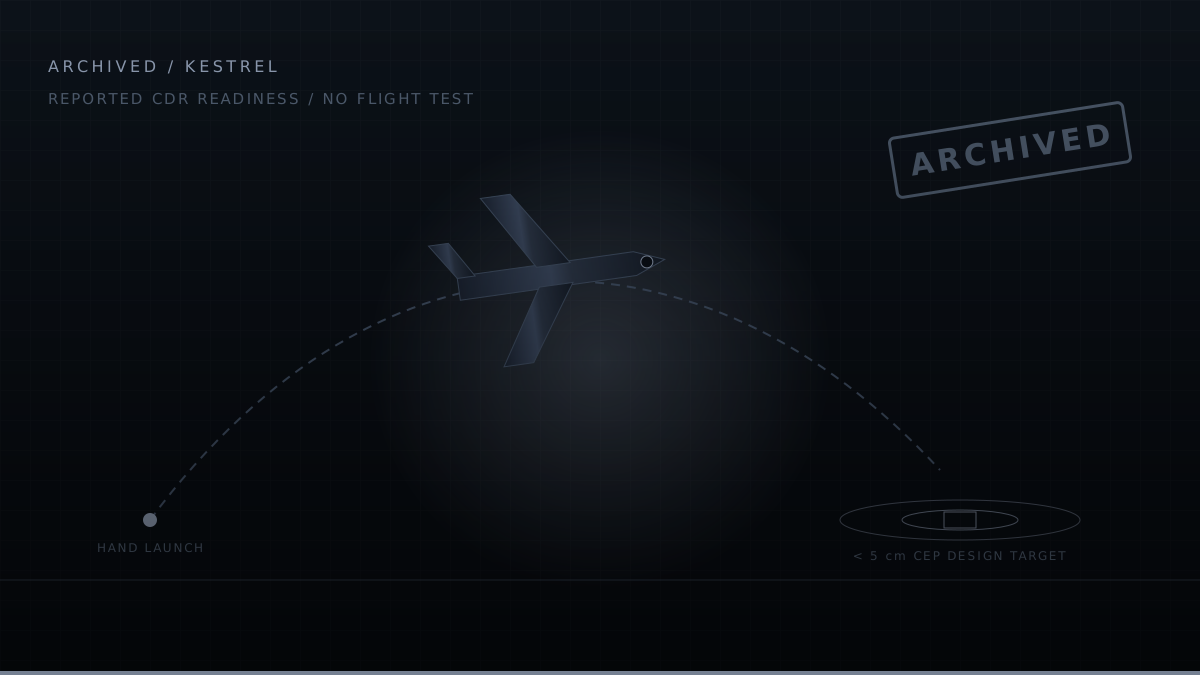
A hand-thrown autonomous UAV concept targeting recovery to a marked pad with sub-5 cm circular error probable using vision-only terminal guidance. The closeout record reached CDR readiness, but no hardware qualification or flight campaign followed. This page separates design intent from evidence.
00Maturity & evidence ledger
Claim boundary: KESTREL produced a requirements and architecture record that was closed out at reported CDR readiness. It did not produce a qualified airframe, flight-test dataset, or demonstrated landing-accuracy result.
Evidence source: programme closeout narrative. No source repository, CDR package, bench log, or flight artifact is publicly linked.
| Evidence layer | Recorded outcome | Public artifact | Claim allowed |
|---|---|---|---|
| Requirements | Targets and intended verification methods defined | Portfolio summary only | Design intent |
| Architecture | Vehicle, avionics, and terminal-guidance concept recorded | No public design package | Design approach |
| Readiness review | Closeout record states CDR readiness | No public board record | Reported maturity |
| Hardware qualification | Not completed | None | No qualification claim |
| Flight performance | Not tested | None | No accuracy claim |
01Problem
A small UAV that can be thrown by hand and recovered to a precise, pre-marked point without GNSS has obvious utility: no launch equipment, no runway, no dependence on a satellite constellation that may not be available. The difficulty is entirely in the terminal phase. GNSS-quality position is metres; the requirement here was centimetres, which means the last few seconds have to be flown on vision.
Problem statement. Recover a hand-launched UAV to a marked landing pad with sub-5 cm CEP, using vision as the sole terminal position reference.
02Requirements
| ID | Requirement | Value | Verification |
|---|---|---|---|
| KS-001 | Landing accuracy shall meet the precision target | < 5 cm CEP | Flight test campaign |
| KS-002 | Launch shall require no ground equipment | Hand throw | Demonstration |
| KS-003 | Terminal guidance shall not depend on GNSS | Vision only | Inspection + test |
| KS-004 | Transition from launch to stable flight shall be autonomous | Throw detection | Flight test |
| KS-005 | Autopilot shall be a flight-proven platform | Pixhawk 6C | Selection review |
03Design approach
The recorded design specified a vision-only extended Kalman filter as the intended terminal position reference, fusing pad-relative visual measurements with inertial propagation on a Pixhawk 6C flight controller. The launch transient, a hand throw imparts a large, poorly characterised initial rate, was treated as a distinct flight phase with its own detection logic and recovery mode rather than as an edge case of normal flight.
| Autopilot | Pixhawk 6C |
|---|---|
| Terminal navigation | Vision-only EKF, pad-relative |
| Launch mode | Throw detection with autonomous stabilisation recovery |
| Accuracy target | < 5 cm CEP at touchdown |
| Maturity reached | CDR readiness |
04Status at closeout
- The closeout narrative records a requirements set with verification methods assigned; the source package is not public.
- The recorded design specified a vehicle configuration and avionics architecture; no public review package is available.
- The narrative describes a vision-only terminal-guidance concept; no public analysis artifact is available.
- The closeout record reports CDR readiness; no public board disposition is available.
- No flight test campaign executed, the programme closed before hardware qualification.
The sub-5 cm CEP figure is a design target that was never flight-demonstrated. It is reported here as a requirement, not as a result, and it should not be read as one.
05Why it stopped
KESTREL was archived because its most valuable technical content, vision-only terminal guidance in the absence of GNSS, was a strict subset of a more general problem, and pursuing the more general problem was the better use of the time. GHOST-X addresses GPS-denied state estimation with occlusion tolerance and a target track, on hardware that is easier to iterate on than a throw-launched airframe.
Continuing KESTREL would have meant building an airframe and a flight-test campaign to demonstrate a navigation capability that could be demonstrated more directly, and more rigorously, on a bench. That is a scope decision, and it is worth stating as one rather than letting the project quietly go stale.
06Lessons learned
- Separate the hard part from its packaging. The interesting engineering was the estimator; the airframe was a delivery mechanism that carried most of the schedule risk.
- A design target is not a result. Numbers that have not been measured should be labelled as requirements every time they are quoted.
- Killing a project is a legitimate engineering decision. The failure mode is not stopping, it is continuing out of sunk cost.
- Treat transients as phases. Designing an explicit throw-detection and recovery mode was more robust than trying to make the nominal controller tolerate the launch transient.
- Write the closeout. A project without a closeout leaves its lessons undocumented and its status ambiguous.
07What carried forward
KESTREL's central question—how to maintain useful position information without GNSS—helped motivate the narrower, more testable estimator work in GHOST-X. GHOST-X owns the public implementation and test evidence; KESTREL is presented only as the archived design context that helped shape that direction.