Home / Projects / AeroFrame-DT
AeroFrame-DT
STRESS · FE VERIFICATION · ALLOWABLES · FATIGUE · DAMAGE TOLERANCE · DIGITAL THREAD
One synthetic aircraft fitting taken from load basis to a reviewable stress record. The work pairs hand methods with FE, audits the material basis, propagates corrections, and records assumption and material-basis changes in the revision history.
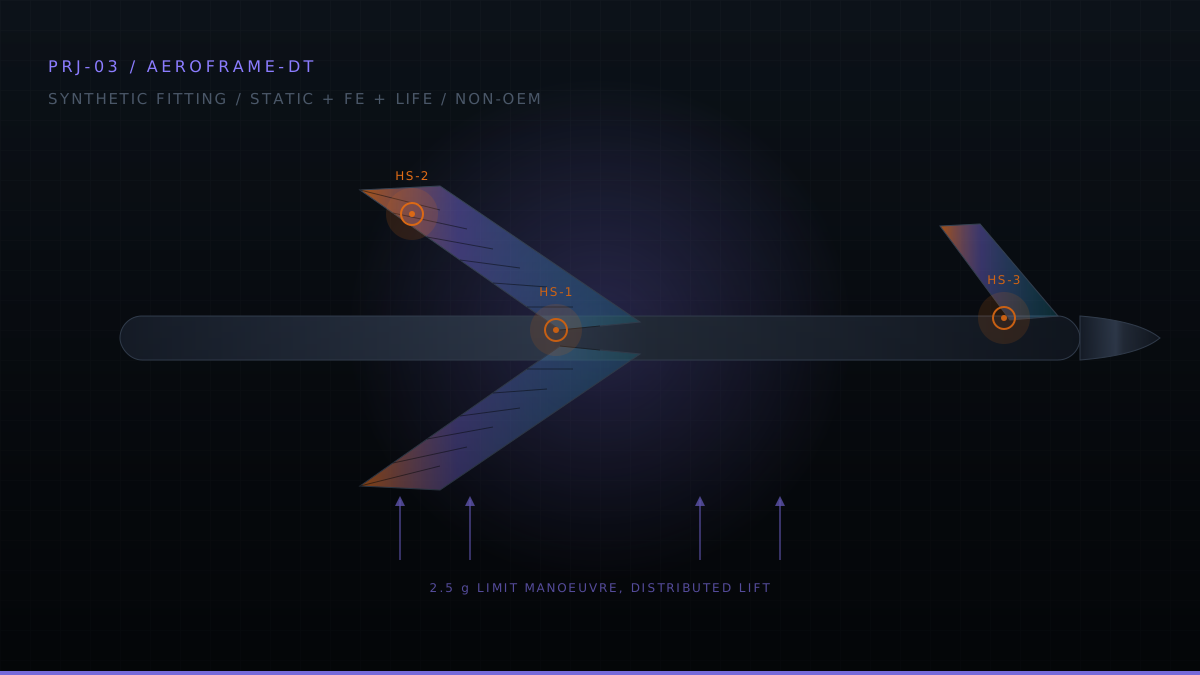
01Released result
The released configuration uses 7050-T7451 plate with MMPDS-2026 A-basis allowables. Combined bearing and transverse behavior at the lug bore governs.
Source of record: Margin Summary. A positive nominal margin is not presented as proof of robustness to every model-form uncertainty.
02Evidence, with basis kept attached
These plots are checked into the analysis repository and generated from recorded runs. The first two are 7075-T651 correlation-specimen studies; they test the method and FE behavior, but they are not plots of the released 7050-T7451 fitting. That distinction matters.
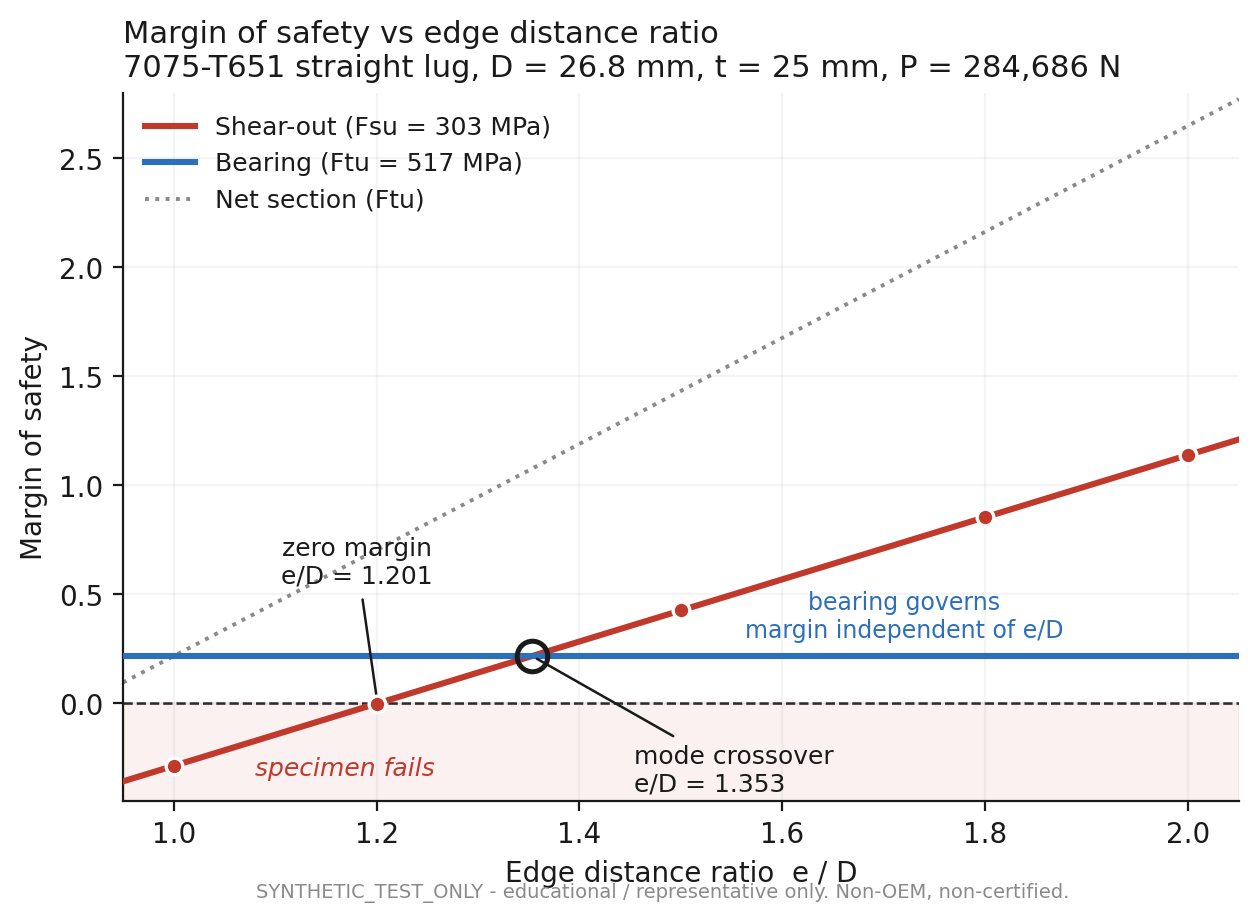
Failure-mode crossover
The sweep makes the zero-margin shear-out threshold and the transition to bearing control visible. It uses 7075-T651 specimen data, not the final 7050 fitting.
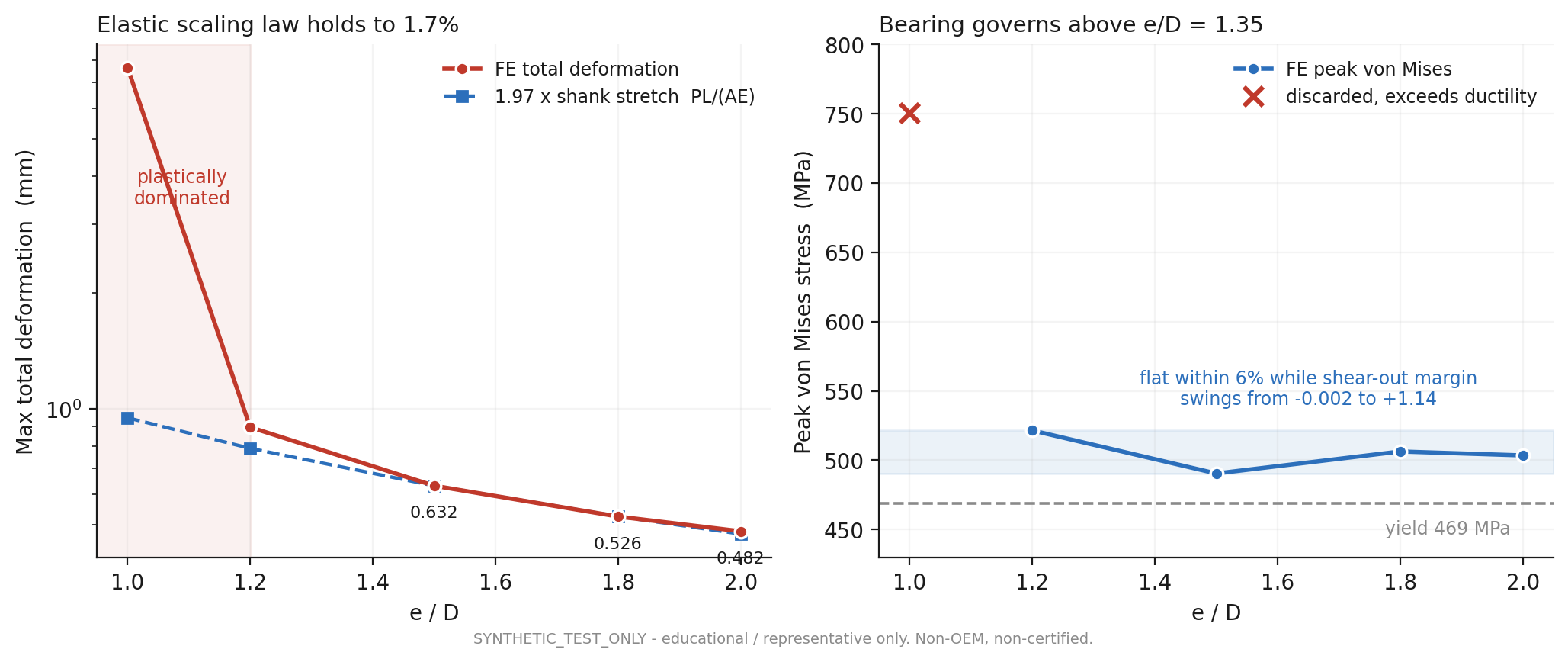
Response across geometry
Total deformation follows the elastic scaling law to 1.7% outside the plastically dominated point, while the peak stress stays comparatively flat after bearing governs.
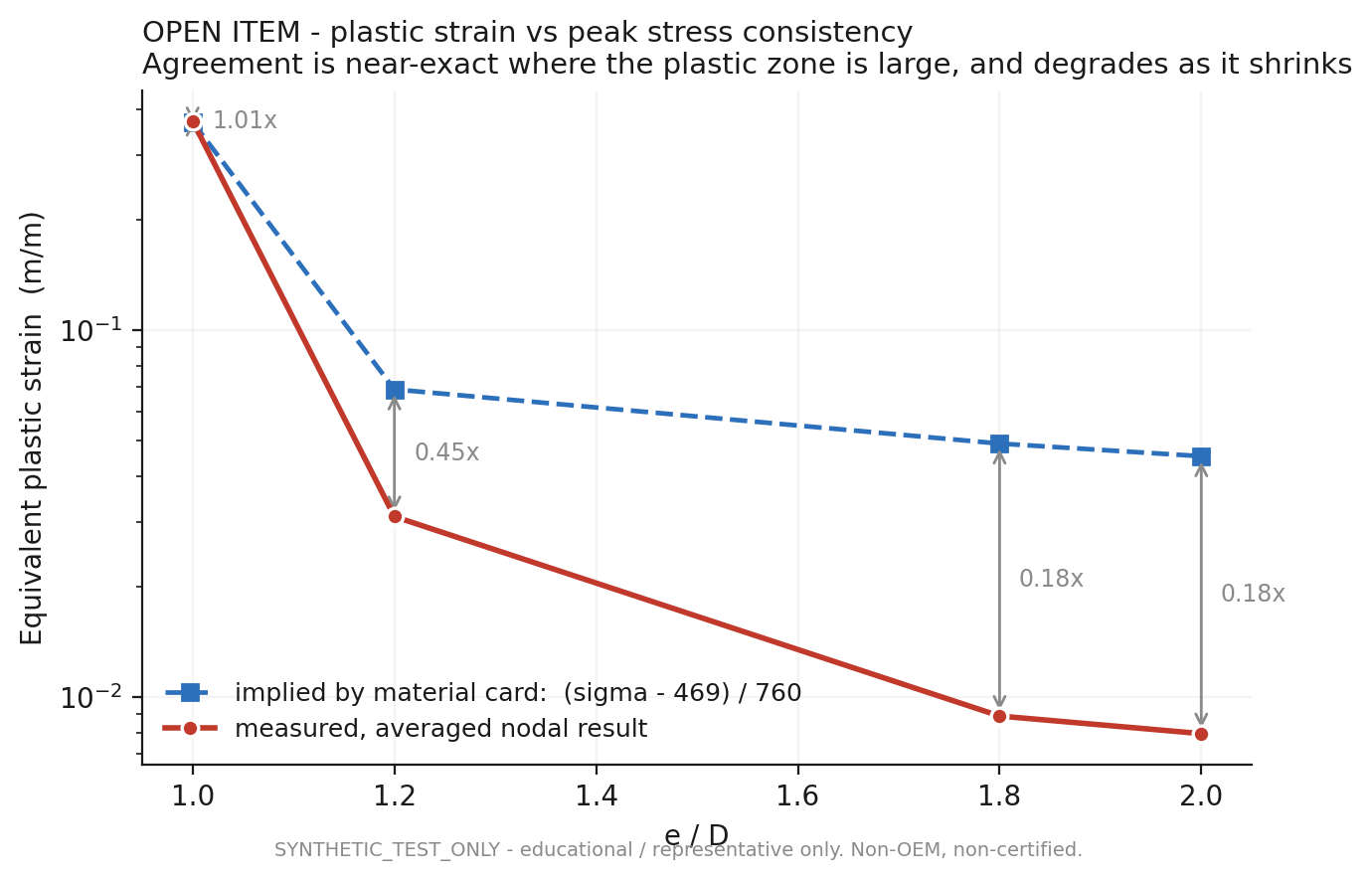
Disagreement is shown, not hidden
The plastic-strain check agrees near the largest plastic zone and degrades as the zone shrinks. It remains an unresolved consistency finding, not a validation result.
03Analysis chain
| Stage | Question | Method |
|---|---|---|
| Loads | What is the declared structural demand? | Free-body and provenance-controlled load basis |
| Static strength | Which local mode governs? | Lug, bearing, shear-out, pin and fastener checks |
| FE verification | Do the hand-method assumptions hold? | Linear, contact, elastic-plastic, modal and buckling models with benchmarks |
| Allowables | Is the material basis current and applicable? | MMPDS citation audit and material reselection |
| Life | What does cyclic damage imply? | Miner safe-life and Paris crack-growth calculations |
| Manufacturing | Do stock, tolerances and inspection change the answer? | Tolerance stack, process planning and inspection trades |
| Configuration | Can the analysis survive rework? | Revision-aware JSON, SQLite and DOT digital thread |
04The correction trail is part of the result
The headline margin moved by a factor of roughly 4.7. The analysis first removed an invalid uniform-bearing assumption, then replaced optimistic allowables, and finally found that the selected 7075-T7351 plate was not tabulated thick enough for the required six-inch stock envelope. That forced the released material to 7050-T7451.
| Stage | Margin | What changed |
|---|---|---|
| Initial hand analysis | +0.710 | Initial assumptions |
| Thick-lug correction | +0.165 | Uniform-bearing assumption removed |
| Real A-basis allowables | +0.078 | Material strength basis corrected |
| Elastic-plastic contact, 7075 | +0.156 | Local redistribution measured |
| 7050-T7451 release | +0.151 | Manufacturable material basis restored |
The +0.078 value remains here only as a superseded point in the revision history. It is not the current AeroFrame result.
05Verification record
- Independent reconstruction of the hand method agrees to 0.06%.
- Refined FE equilibrium closes to 0.006%; recorded elastic-plastic runs close to 10 ppm.
- Continuum cantilever and plate-bending benchmarks agree within 0.20% and 0.62%, respectively.
- Two damage-tolerance implementations agree to 7% on critical crack.
- Exact and linearized tolerance sensitivity agree to 0.1%.
- Formal traceability closes 18 requirements with 45 verification rows.
- REQ-012 is verified against a synthetic spectrum; that result does not establish adequate flight-article fatigue life.
- Cross-solver NASTRAN decks and predictions exist, but the runs are still open.
Evidence snapshot: source commit 22c7740. Review the verification matrix, 7050 damage-tolerance update, safe-life record and software completion matrix.
06Claim boundary
- Traceable load-to-margin workflow
- Hand / FE assumption checking
- Published allowables governance
- Fatigue and damage-tolerance calculations
- Manufacturing and inspection integration
- Revision-aware requirement evidence
- OEM geometry or loads
- Certified stress substantiation
- Flight-article approval
- Licensed-engineer signoff
- That the synthetic fitting represents a production joint
- That the unresolved correlation items are closed
Geometry and loads are synthetic. Material allowables are real and cited. The project demonstrates engineering method and self-correction; it does not substantiate an aircraft.